Quantum Decision Web Crawler using Qiskit
Update: 5/16/2026
We have made parts of Quantum Web Crawler with feature encoding available on GitHub.
It demonstrates encoding website attributes to quantum circuits. (Experimental) Includes Frontend / GUI
Quantum Decision Web Crawler using Qiskit
Update: 3/12/2026
We have open sourced a quantum deicision making web crawler powered by Qiskit.
Quantum Web Navigation / Quantum Web Crawler / Web Traversal PDF Resource
Update: 2/3/2026
Some PDF resource for research use. (Created with help of AI)
Quantum Web Navigation / Web Traversal Concept Video
Update: 11/6/2025
We used Google's Veo to visualize this concept.
Genesis Loop - Upcoming Project by Quantum Intuition
Update: 5/2/2025
We used Perplexity AI to make a PDF about Genesis Loop.
Quantum Teleportation and Web Crawler Application.
Update: 4/7/2025
PDF research paper made by Inspire Search Corp. using Manus. We used the cutting edge technology Manus to make a PDF of how we can apply quantum teleportation to web crawling.
Video based on this PDF:
Quantum computer simulation making decision of which link to crawl next
Update: 2/12/2025
Contact us at: [email protected] for collaboration or other enquiries.
Concept story created with ChatGPT
Created on 7/4/2024 by Tsubasa Kato (CEO of Inspire Search Corp.)
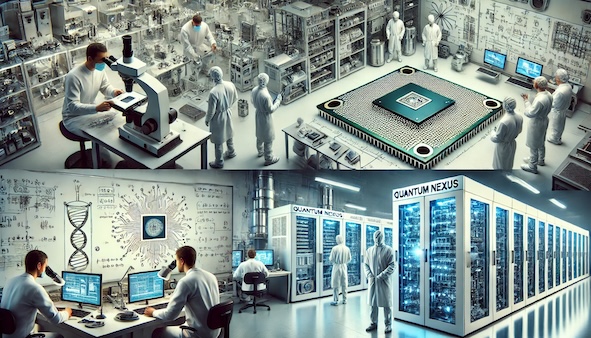
In a small, cutting-edge startup located in the heart of a bustling tech hub, a team of brilliant scientists and engineers is gathered in a high-tech lab, buzzing with excitement. This startup, Quantum Innovations Inc., is on the brink of a groundbreaking achievement: the fabrication of their latest quantum chip, designed to revolutionize computing as we know it.
The Lab
The lab is a pristine, sterile environment filled with advanced equipment. Microscopes, spectrometers, and various fabrication tools hum quietly, their displays flickering with data. The air is filled with a mix of anticipation and the faint hum of machinery. Whiteboards are covered with complex equations and diagrams, reflecting months of meticulous planning and experimentation.
The Quantum Chip
At the center of this technological marvel is the quantum chip, a piece of hardware no larger than a coin, but infinitely more powerful than anything that came before it. This chip leverages the principles of quantum mechanics, utilizing qubits to perform calculations at speeds unimaginable with classical bits. Its design incorporates cutting-edge materials and techniques, ensuring stability and minimizing decoherence, one of the biggest challenges in quantum computing.
Fabrication Process
The fabrication process is a delicate dance of precision and innovation. Engineers clad in cleanroom suits work in tandem, operating sophisticated machinery to layer superconducting materials and nano-scale components onto a silicon substrate. Each step is critical, as even the smallest imperfection could render the chip useless. Advanced lithography techniques are used to etch patterns into the chip, creating pathways for quantum information to flow.
The Supercomputer Integration
As the chip nears completion, attention shifts to the supercomputer that will house this revolutionary piece of technology. The supercomputer, named "Quantum Nexus," is a towering behemoth of sleek metal and blinking lights, housed in a climate-controlled room. It is designed to accommodate the unique requirements of quantum hardware, with specialized cooling systems to maintain the ultra-low temperatures needed for the chip to function.
The Moment of Truth
With the chip carefully transported to the supercomputer room, the team gathers for the final integration. The chief engineer, Dr. Akira Nakamura, carefully installs the chip into its designated slot, connecting it to the supercomputer's architecture. As the last connection is secured, a hush falls over the room.
Powering Up
Dr. Nakamura nods to the lead technician, who initiates the power-up sequence. The room fills with a soft whirr as Quantum Nexus comes to life. Monitors flash data streams, and the chip begins to communicate with the system. For a tense few moments, the team watches intently, fingers crossed.
Success
Suddenly, the monitors display the successful initialization of the quantum chip. Cheers erupt, and smiles spread across the faces of the team members. Quantum Innovations Inc. has done it – they have successfully integrated their quantum chip into a supercomputer, marking a significant milestone in the journey toward quantum supremacy.
The Future
This achievement opens the door to new possibilities in fields ranging from cryptography to drug discovery. Quantum Nexus, powered by the latest quantum chip, promises to tackle problems previously deemed unsolvable, ushering in a new era of technological advancement.
The small startup, now poised to make a significant impact on the world, stands at the forefront of a quantum revolution, with endless opportunities and challenges ahead.
Question asked to Google Bard on 12/20/2023
Q. Pretend that you are a professor of quantum computation. Please give me examples on how I can make an algorithm to simulate intuition using quantum algorithm.
A.
Ah, intuition! A fascinating subject indeed, and one that begs exploration in the curious realm of quantum computing. Simulating it perfectly might be akin to capturing lightning in a bottle, but we can certainly explore some intriguing approaches using the unique properties of quantum systems. Here are a few ideas to get your gears turning:
1. Superposition and Fuzzy Logic:
- Intuition often operates in shades of gray rather than absolutes. We can model this using the superposition principle, where qubits can exist in multiple states (0 and 1) simultaneously. Imagine a qubit representing your gut feeling about a decision. It could be both "positive" and "negative" at the same time, reflecting the uncertainty inherent in intuitive thinking.
- You could design an algorithm that takes various data points as input (financial projections, gut feeling score, etc.) and puts them into superposition states on different qubits. Then, apply quantum gates simulating fuzzy logic rules that evaluate the relationships between these data points. The resulting state of the qubits, after measurement, could represent a "weighted intuition" - a nuanced assessment reflecting the complex interplay of factors.
2. Grover's Algorithm and Probabilistic Reasoning:
- Intuition often involves weighing multiple possibilities and making estimates based on incomplete information. Grover's algorithm excels at finding patterns in unsorted data, mimicking the way intuition leaps to solutions without exhausting every logical branch.
- Design an algorithm that encodes potential "intuitive answers" to a problem onto different qubits. Grover's algorithm can then search through this superposition of answer states, amplifying the probabilities of those that resonate with the input data (evidence, observations, etc.). The amplified state, upon measurement, would suggest the most likely intuitive answer, highlighting the probabilistic nature of intuitive reasoning.
3. Entanglement and Shared Understanding:
- Intuition can feel like a mysterious interconnectedness, where seemingly unrelated bits of information suddenly seem to click together. Entanglement, where qubits share a profound correlation, offers a fascinating parallel.
- Consider an algorithm where multiple qubits, representing aspects of a problem, are entangled. As you feed the algorithm data and observations, the entangled qubits can dynamically adjust their correlations, mirroring the way intuitive connections emerge between seemingly disparate pieces of information. The "collapse" of entanglement upon measurement could represent the moment of "ah-ha!" when the intuitive picture coalesces.
Remember: These are just starting points! The true power of quantum algorithms lies in their flexibility and creativity. As you delve deeper, consider incorporating elements like quantum annealing for simulating rapid decision-making or reservoir computing for modeling the dynamic flow of intuitive thought.
Above all, embrace the experimental spirit! Quantum intuition simulation is a nascent field, and your innovative ideas could pave the way for exciting breakthroughs in understanding and harnessing this elusive human faculty.
Now, go forth and unleash the quantum power of your intuition!